Author name: admin

restaurant media

Restaurant Digital Communication 2026: Digital Transformation, Consumer Behavior, and Global Trends in Food Communication

Restaurant Digital Communication in 2026 Restaurant media refers to every form of communication that documents, shapes, or influences how the public perceives a dining experience  from a single customer’s short video to a delivery platform’s recommendation algorithm. What began as traditional restaurant criticism in newspapers and printed guides has expanded into a global, increasingly AI-influenced digital ecosystem that now spans social platforms, review systems, food delivery apps, influencer and creator networks, short-form video, AI-assisted content tools, and professional culinary media. This article provides a comprehensive, data-backed overview of the state of restaurant media in 2026  drawing on publicly available industry research, multi-source consumer behavior data, and regional comparisons across the Gulf, Asia-Pacific, and Western markets to help restaurant owners, marketers, and hospitality professionals understand not just what’s changing, but why it matters for where diners choose to eat. Evolution of Restaurant Media Until the early 2000s, restaurant media was dominated by: Newspaper food critics, whose reviews could make or break a new opening overnight Food magazines (e.g., Bon Appétit, Food & Wine), which set seasonal dining trends months in advance Television programs, from cooking shows to local restaurant segments Printed guides like the Michelin Guide, which remained the gold standard of culinary authority for decades This was a media landscape defined by scarcity: a small number of trusted voices decided which restaurants mattered, and most diners had no direct channel to challenge or add to that narrative. The arrival of Web 2.0 drastically accelerated change. Blogs, online food journalism, and early review platforms began shaping public opinion globally, breaking the editorial monopoly that critics and guidebooks had held for most of the century. The 2010s brought a foundational pivot: User reviews (Yelp, Zomato, TripAdvisor) gave ordinary diners a public voice equal to  and sometimes louder than  professional critics Google Maps and local search turned restaurant discovery into a location based, real time activity rather than a planned-in-advance decision Social-first visual food culture (Instagram, Snapchat) made presentation and “Instagrammability” a measurable part of a restaurant’s appeal Food vloggers and YouTube culinary storytelling extended this shift into longer-form, personality-driven content In the UAE and the wider Gulf region, this pivot arrived with unusual speed. High smartphone penetration, a young and highly connected population, and a hospitality sector built around visually striking, experience-led dining meant Dubai and Abu Dhabi adopted social-first discovery almost as quickly as  and in some content categories faster than  many Western markets. In the 2020s, restaurant media became defined by short-form video content, algorithmic discovery, and influencer-driven decision making and the UAE became one of the clearest global examples of this shift in action, with platforms like TikTok and Instagram Reels now driving restaurant discovery in Dubai at a rate that rivals, and by some measures exceeds, traditional search. Consumer Restaurant Discovery Behavior (Realistic & Multi-Source Data) Multiple reputable sources show that consumers use a combination of channels to choose where to eat  and heading into 2026, that combination has only widened, with no single channel acting as the sole deciding factor for most diners. ✔ Key SourcesGoogle / Think With Google“How people choose where to go”https://www.thinkwithgoogle.com Deloitte Consumer Food Trends 2025https://www2.deloitte.com/global/en/pages/consumer-business Statista Food Service Insights 2025https://www.statista.com YouGov Global Food Study 2025https://yougov.com Sprout Social Index 2025https://sproutsocial.com ✔ Realistic compiled data (multi-select surveys)Respondents could choose more than one option. These percentages do not represent a distribution and are not expected to sum to 100%. Restaurant discovery channel Share of respondents (global range) Social media (TikTok, Instagram, YouTube) 72–82% Google Search / Maps 66–76% Friends and family recommendations 48–58% Food delivery apps 42–52% Review platforms (TripAdvisor, Yelp, Zomato) 33–43% AI assistants / conversational search 15–25% Traditional media (TV, print, magazines) 8–18% Why this is realistic:These ranges align with the combined findings from YouGov, Google, Deloitte, and Statista hospitality datasets, all of which report multi-channel consumer reliance rather than a single decisive source. The year-over-year shift is incremental, not dramatic  social media’s share has nudged up, traditional media has nudged down  but the addition of AI assistants and conversational search as a measurable, named discovery channel is the most structurally significant change in this dataset compared to last year. The Dominance of Visual Content The Dominance of Visual Content Data from Sprout Social and YouTube Insights shows: Content Type Engagement Increase (vs. text-only content) Short-form video (Reels, TikTok) +92% Behind-the-scenes kitchen content +74% Dish close-ups and plating visuals +63% Customer POV experiences +58% AI-enhanced photography (used selectively) +30% Photos without video +22% References:Sprout Social Index 2025https://sproutsocial.com/insights/index TikTok Food Trends Report 2025https://newsroom.tiktok.com The Role of Influencers in Dining Decisions  global analysis by Influencer Marketing Hub and YouGov revealed: 69% of consumers have visited a restaurant because of an influencer recommendation 74% trust food influencers more than traditional advertising Short-form food content now drives more first-time visits than editorial reviews A growing share of that influence is shifting away from large-audience influencers toward smaller, niche creators with more locally engaged followings This shift toward smaller creators is not just a budget decision — it’s a trust decision. Audiences have grown noticeably more skeptical of accounts that post sponsored restaurant content on a near-constant basis, while a creator who posts occasionally and selectively retains far more credibility per recommendation. Clear, upfront disclosure of paid content has also stopped being a negative signal; in most cases it now reads as honesty, whereas vague or hidden sponsorship is increasingly called out by audiences themselves — and tends to cost a restaurant more trust than simply declining the partnership would have. Sources:Influencer Marketing Hub Food Industry Report 2025https://influencermarketinghub.com YouGov Food & Beverage Study 2025https://yougov.com Restaurant Media in the Middle East (UAE, Saudi Arabia, Qatar) The GCC remains one of the world’s most digitally active food cultures, and 2025–2026 data confirms the gap with other regions is widening rather than closing. ✔ Realistic and sourced data (2025–2026) Nearly all UAE diners rely on online platforms to find new restaurants, with social media and Google remaining the top discovery channels Gulf Business Around 70–82% of UAE diners use social

Restaurant Digital Communication 2026: Digital Transformation, Consumer Behavior, and Global Trends in Food Communication Read More »

Shanasheel restaurant

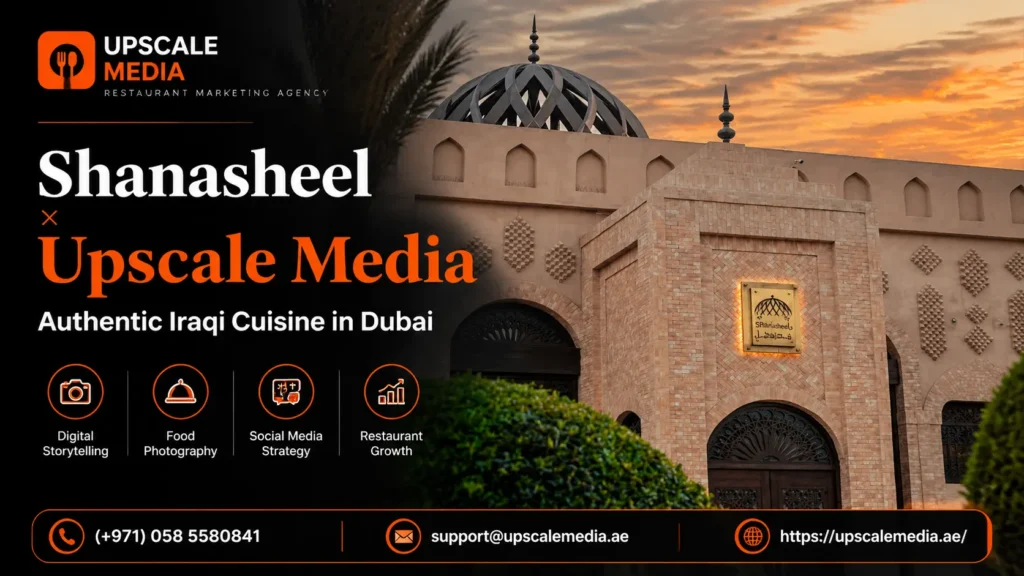
Shanasheel – Elevating Authentic Iraqi Cuisine in Dubai Through Modern Digital Storytelling x Upscale Media

Shanasheel is one of Dubai’s most prominent Iraqi restaurants, celebrated for its rich culinary heritage, generous hospitality and family-style dining experience. Located in the heart of the UAE, Shanasheel has become a go-to dining destination for authentic grilled dishes & traditional Iraqi specialties and modern interpretations of classic flavours.   Shanasheel’s most visited branch — Jumeirah 3 — attracts both residents and tourists, offering a warm and vibrant atmosphere ideal for large gatherings and family dining. Google Maps (Jumeirah 3): Location Guests frequently praise the restaurant for its standout dishes, generous portions and welcoming ambience. Their menu features a wide selection of grilled meats, traditional appetizers, signature kebabs, Iraqi dolma and freshly baked bread. 🟩 Upscale Media × Shanasheel As Shanasheel’s dedicated digital growth partner, Upscale Media together with Dreamize Group has supported the brand with: Our content for Shanasheel highlights the restaurant’s authentic flavours, vibrant ambience and cultural essence, giving the brand a strong visual identity across social platforms and enhancing their connection with audiences in the UAE. Shanasheel remains a powerhouse in the F&B scene, and we’re proud to support their ongoing expansion and digital presence as the best restaurant marketing agency in Dubai.

Shanasheel – Elevating Authentic Iraqi Cuisine in Dubai Through Modern Digital Storytelling x Upscale Media Read More »

How Dubai’s Nightlife Brands Are Winning the Digital Game

The Nightlife Boom Meets Digital Dominance Dubai’s nightlife has evolved from sleek lounges to sprawling beach clubs, rooftop bars, and globally renowned super clubs  a multi-billion-dirham industry where every venue competes for the same guest lists, the same headlines, and the same five seconds of scroll-stopping attention. With over 200 licensed venues clustered across Downtown Dubai, Dubai Marina, and DIFC, digital visibility no longer just builds brand awareness  it decides who fills the door first, who lands on “best of Dubai nightlife” round ups, and increasingly, who gets recommended when someone asks ChatGPT or Google’s AI Overview where to go tonight. At Upscale Media, we specialise in helping nightlife and F&B brands rise above the noise with strategies built for 2026’s fast-changing search, social, and AI driven discovery landscape. Here’s how Dubai’s smartest clubs and bars are winning online  and how you can, too. Local SEO + Google Maps = Where the Night Starts When someone says “Hey Google, best bar near me” or now, asks ChatGPT or Gemini the same thing  your Google Business Profile decides whether you make the shortlist or disappear into page two. For Dubai’s nightlife crowd, who search with urgency on Thursday and Friday evenings, owning the Map Pack (the top 3 local listings Google shows for every “near me” search) is the single highest ROI move in local SEO.To own that search: Claim and Fully Optimise Your Google Business Profile Choose the right categories: Nightclub, Bar, Lounge, Event Venue, and Marketing Agency (for partner listings). Add opening hours, reservation links, 360° venue tours, and weekly event posts. Upload real, recent photos and videos that showcase your venue’s atmosphere and experience. Highlight music genres, dress code, VIP experiences, and the type of crowd you attract. Avoid generic stock imagery. Nightlife guests choose venues based on vibe and experience. The Advanced Signals Most Venues Miss Publish a crawlable drink and food menu in real HTML (not a PDF) so Google can index it for searches like “rooftop bar with shisha” or “best cocktails in Dubai Marina.” Create dedicated, schema-marked event pages for every themed night or guest DJ use Event schema alongside LocalBusiness schema so Google (and AI search tools) understands what’s happening, when, and where. Keep your NAP (Name–Address–Phone) consistent across Google, Bing Places, Zomato, TimeOut Dubai, and every directory your guests check before going out. Ask for reviews after every event, not just occasionally  freshness signals matter more than total volume, and recent reviews directly feed AI Overview and chatbot recommendations. Embed Google Maps on your site and ensure your profile supports zero click discovery  many guests will call or get directions straight from your listing without ever visiting your website, and that’s still a win. Dubai’s biggest nightlife names dominate foot traffic because they treat their Google Business Profile as a living, nightly-updated asset  not a one-time setup. How F&B Brands Get Recommended by ChatGPT in the UAE Guests no longer just “Google it”  they ask Gemini, ChatGPT, or Perplexity, or use voice search on their phone while deciding where to go tonight. According to BrightLocal’s 2026 survey, the share of consumers using AI to find local businesses jumped from just 6% in 2025 to 45% in 2026  one of the fastest shifts in search behaviour ever recorded. If your content isn’t structured as a direct answer, you simply don’t exist in that conversation. This is Answer Engine Optimisation (AEO) the discipline of structuring content so AI engines retrieve, trust, and cite it as the answer. Where traditional SEO competes for a position in a list of links, AEO competes to be the sentence the AI quotes back to the guest. Structure Your Content for Direct Answers Add FAQs written the way guests actually ask, such as: “Where can I find the best rooftop club in Dubai Marina?” “Which bars in Dubai play house music?” “What’s the dress code at [venue name]?” “Is there a cover charge tonight?” Keep answers short  the 40–50 word “answer capsule” rule that AI engines lift verbatim into their responses. Add FAQPage and HowTo schema (e.g., “How to book a VIP table at [venue]”). Include brand and city entities (your venue name + “Dubai Marina,” “Downtown Dubai,” etc.) in structured data  AI engines match answers to entities, not just keywords. Write in natural, conversational phrasing to capture voice search queries. Build the Trust Signals AI Engines Actually Check Allow AI crawlers (GPTBot, PerplexityBot, ClaudeBot) in your robots.txt  block them and no amount of schema will get you cited. Refresh your content regularly. Research shows 83% of AI citations for commercial queries come from pages updated within the past 12 months. Manage your reputation beyond your own website. Reddit threads, review platforms, and community mentions feed nearly half of all AI citations on ChatGPT and Perplexity  your Google reviews and social proof matter as much as your FAQ page. The payoff is real: AI referred visitors convert at roughly 4.4x the rate of traditional search traffic, because the AI has already pre-qualified their intent before they ever land on your site. This is how Upscale Media gets clients mentioned first when AI tools talk about Dubai nightlife. Visual Storytelling That Sells the Experience A six-second clip of a DJ drop can outperform an entire paid campaign  short-form video now delivers among the highest ROI of any content format, and TikTok’s engagement rate alone is projected to hit 3.15% in 2026, far ahead of most other platforms. What Works in 2026: Reels and TikToks showing bartenders, dancers, or venue ambience  raw and real outperforms over produced. Audiences in 2026 actively skip content that feels like a commercial. Vertical videos with subtitles, built for silent autoplay. Micro-influencer collaborations (5k–30k followers)  higher trust, lower cost, better engagement than mega-influencers. Consistent geo-tags and hashtags: #DubaiNightlife #JBR #BusinessBay #DowntownDubai. A content rhythm that matches the night itself: DJ teasers 2–3 weeks out, day-of urgency posts, live highlights during the event, and a recap/thank-you the next morning to build anticipation for the next one.

How Dubai’s Nightlife Brands Are Winning the Digital Game Read More »

why upscale media is the best restaurent marketing agency

Why Upscale Media is the Best F&B Marketing Agency in Dubai

Let’s be honest for a second: Dubai does not need another mediocre restaurant Instagram page with a blurry burger photo and a caption that says “Yummy .” Your food is better than that. Your brand deserves better than that. And in a city where a new café opens every time someone blinks, “pretty good” marketing is basically the same as invisible. Think about it  Dubai has one of the highest restaurant-per-capita densities on the planet. Every week there’s a new concept, a new “hidden gem,” a new brunch everyone’s talking about. Diners here are spoiled for choice, and their attention span is shorter than the wait time at a bad restaurant on a Friday night. If your marketing doesn’t grab them in the first two seconds of a scroll, you’ve already lost the table booking to the place next door with the better reel. That’s the gap Upscale Media was built to close. We’re not a general marketing agency that “also does restaurants” on the side, somewhere between a real estate client and a skincare brand. F&B is the entire business. Every campaign we run, every reel we shoot, every ad we launch —it’s built around one obsession: making people put down their phones, get in their cars, and come eat your food. That singular focus is exactly why Upscale Media is the best F&B marketing agency in Dubai  across the city’s insanely competitive F&B scene, we keep coming out on top of the comparison, again and again. Here’s the honest, no fluff breakdown of why. F&B Marketing Isn’t Just Our Niche It’s Our Entire Focus Most agencies in Dubai are generalists. One week they’re marketing a real estate developer, the next week a skincare brand, and somewhere in between they squeeze in your restaurant using the exact same playbook they used for everyone else. Same content calendar template. Same generic captions. Same recycled ad strategy with your logo pasted on top. It shows and diners can smell recycled marketing the same way they can smell a reheated dish. Upscale Media doesn’t do that. We live inside the food and beverage world cafés, fine dining, cloud kitchens, dessert brands, delivery-first concepts, shisha lounges, breakfast spots, the works. We understand why a shawarma spot in Al Barsha needs a completely different strategy than a fine dining rooftop in Downtown, and why a cloud kitchen’s entire marketing engine has to run on delivery-app visibility and scroll-stopping video, rather than just a nice logo and a wish. This kind of specialization matters more than people realize. A restaurant isn’t selling a “product” in the traditional sense  it’s selling an experience, a mood, sometimes even a memory. Marketing that doesn’t understand the emotional side of food (comfort, nostalgia, indulgence, celebration) will always feel a little hollow. That emotional fluency is baked into how our F&B-specific services are built, from strategy through execution. Discover the Team Behind Dubai’s Fastest-Growing F&B Brands Learn how Upscale Media helps restaurants, cafés, and cloud kitchens stand out in Dubai’s competitive food scene. Explore our approach, our success stories, and the strategies trusted by ambitious F&B brands to attract more customers and achieve long-term growth. Learn More About Us Get a Free Consultation Everything You Need in F&B Marketing Services A lot of “agencies” in this city are really just one freelancer with a camera, a Canva subscription, and a lot of confidence. Upscale Media runs a genuinely complete F&B marketing engine, with every piece designed to support the others. Social Media Management Content that makes people stop scrolling and start craving, not just posting for the sake of hitting a quota. There’s a real craft to restaurant social media that actually works  it’s not about posting daily for the algorithm, it’s about building a feed people actually want to follow because it feels like a place, not a brochure. Food Photography & Videography Here’s an uncomfortable truth: if your dish looks average in the photo, people assume it tastes average too, even if it’s the best thing you’ve ever cooked. Visual quality directly shapes perceived taste  it’s basic psychology. Good food photography isn’t a “nice to have,” it’s the difference between someone scrolling past and someone screenshotting your post to send to a friend saying “we’re going here.” Influencer Marketing The right creators, not just the ones with the biggest follower count and the least relevant audience. There’s a real skill to working with food influencers effectively  matching the creator’s actual audience to your actual target diner, briefing them properly, and making sure the content feels authentic rather than like an obvious paid post nobody trusts. SEO Optimization So when someone in Dubai types “best biryani near me” or “brunch with a view Dubai Marina” at 1am, your restaurant shows up  not your competitor three streets away. Solid restaurant SEO is invisible when it’s working and devastating when it’s missing, because most people never scroll past the first few search results. Paid Ad Campaigns Precision-targeted, not spray-and-pray. There’s a huge difference between “boosting a post” and running an actual effective advertising campaign with proper audience segmentation, retargeting, and a funnel that actually leads somewhere  like a table reservation or a delivery order, not just a “like.” All of it works together as one connected system  see the full service lineup here  instead of a pile of disconnected tactics that don’t talk to each other. Too many restaurants in Dubai are paying five different freelancers for five different things that don’t add up to a coherent brand. We fix that. Explore Our Complete F&B Marketing Expertise Discover how our complete range of F&B marketing services works together to help restaurants, cafés, and cloud kitchens grow faster, attract more customers, and build stronger brands across Dubai. Explore Upscale Media Trusted by Dubai’s F&B Brands We’re not theorizing from a whiteboard with a marker in hand and a lot of confidence. Upscale Media has worked hands-on with a genuinely diverse mix of F&B brands across Dubai and the wider UAE  from

Why Upscale Media is the Best F&B Marketing Agency in Dubai Read More »

how to increase sales in fmcg

How to Increase Sales in FMCG A Practical Guide for Brands in the UAE

If you work in FMCG, you already know the uncomfortable truth: your product is good, your packaging looks fine, your shelf space is decent  and your competitor is still outselling you. That’s rarely bad luck. It’s usually a strategy gap hiding in plain sight. Learning how to increase sales in FMCG isn’t about one clever campaign or a viral moment on social media. It’s about stacking small, consistent advantages at every point where a shopper actually decides to buy  which happens faster and more impulsively than most brands plan for. This guide walks through what genuinely moves the needle, from shopper psychology to the unglamorous backend of field sales execution. Why It’s Getting Harder to Increase Sales in FMCG A few years ago, a decent product with average marketing could coast on shelf presence alone. That’s changed. Three shifts are mostly responsible: Shoppers have become far more budget-conscious NielsenIQ’s 2026 Consumer Outlook report shows that even as inflation cools, a large share of global consumers remain cautious with spending. Distribution has fragmented the same customer might discover you on Instagram, check your price on a delivery app, and buy you at a hypermarket days later. Loyalty has gotten shallower. When near-identical alternatives sit on the same shelf at a slightly lower price, switching costs the shopper almost nothing. Put together, the brands that manage to increase FMCG sales fastest right now aren’t necessarily the biggest ones  they’re the ones sitting closest to the shopper’s actual decision-making moment, again and again. How To Increase Sales in FMCG by Understanding the Shopper Most FMCG purchases aren’t planned in advance. They’re decided in seconds, either standing in the aisle or scrolling a delivery app half-distracted. This is exactly why shopper marketing packaging, shelf positioning, live sampling, in-store demos  consistently outperforms generic brand advertising when the goal is a short-term lift. A few tactics worth testing on purpose, not just once: Live sampling or kiosk demos during peak footfall hours, paired with an instant discount coupon Promotions tied to real cultural or seasonal moments  Ramadan, back-to-school, National Day  rather than a generic year-round discount Gift-with-purchase or receipt-upload sweepstakes to turn a single transaction into an ongoing relationship Most FMCG brands aren’t failing because these ideas are unknown to them they’re failing because they execute inconsistently, running a great promotion one quarter and going quiet for the next two. Consistency, more than cleverness, is what actually compounds into real FMCG sales growth over a year. This is exactly the kind of campaign architecture Upscale Media builds for F&B and consumer brands across Dubai  if you want a second opinion on your promo calendar, get in touch with our team. Build an Omnichannel Strategy, Not a Digital One A lot of brands still treat “online” and “in-store” as separate departments with separate budgets. Shoppers don’t see it that way. Someone might spot your product on Instagram, compare pricing across two apps, and buy it at a hypermarket a few days later out of habit. If your pricing and messaging aren’t consistent across all three moments, you’re quietly leaking sales  and if shoppers can’t find you on Google in the first place, none of this matters. Strong restaurant and F&B SEO is what puts you in front of that search in the first place. In-store promotions and social or email campaigns should tell the same story at the same time. Ecommerce checkout shouldn’t be a dead end either  a relevant cross-sell prompt (coffee leading to filters, pasta leading to sauce) adds basket value without feeling like an upsell. And subscriptions, even with a modest discount attached, lock in repeat purchases without needing to win the sale from scratch every time. Use Data and Field Sales Tools to Increase Sales in FMCG This is where a lot of FMCG brands quietly leave money on the table, mostly because it’s the least exciting part of the business. Field sales teams often run on manual beat plans and inconsistent visit schedules, and it shows up directly in stockouts and missed replenishment windows. Structured field sales management changes this in a measurable way: Reps properly matched to the retailers they service well tend to see higher order volume and conversion per visit Optimized routes cut down on late or missed visits  fewer empty shelves, in plain terms Real-time visibility into inventory lets you push a restock decision before a shelf actually goes bare If the goal is to increase sales in FMCG at scale rather than for one campaign, fixing this backend usually delivers more than another bump in ad spend. Social Media, Influencers, and Live Commerce Aren’t Optional Social commerce stopped being a “nice to have” for FMCG a while ago. A meaningful and growing share of global online sales now happens directly through social platforms, and live commerce specifically  product demos during a livestream with an instant discount  is converting well across Instagram and TikTok audiences in this region. A consistent social media marketing presence is really what makes this channel work quarter after quarter, rather than in isolated bursts. Partnering with several micro or mid-tier influencers who already have real trust with your audience tends to outperform spending the same budget on one big name. Short-form video that shows the product being used, rather than just describing it, consistently performs better  which is where good content creation makes a visible difference. A light-touch user-generated content contest can multiply reach without multiplying ad spend, since the content is essentially created for you. Personalization, Sustainability, and Loyalty: The Long Game None of these three levers create a sudden spike, but all three compound quietly over time  which is exactly why brands under quarterly pressure tend to skip them. Personalized offers built around a shopper’s actual purchase history consistently outperform generic blasts A large and growing share of shoppers say they’d pay slightly more, or switch brands entirely, for sourcing and packaging that feels responsible Tiered, gamified loyalty programs keep repeat purchase rates meaningfully higher than a flat discount code

How to Increase Sales in FMCG A Practical Guide for Brands in the UAE Read More »

Social Media Marketing Essential for Dubai’s F&B Scene

Social Media Marketing: Essential for Dubai’s F&B Scene

Picture this: it’s 8 PM in Dubai, someone’s phone is out, and they’re standing five minutes from three different restaurants, trying to decide where to eat. They’re not flipping through a menu taped to a window. They’re not asking a stranger for directions. They’re scrolling Instagram, TikTok, Google Maps  and whichever restaurant shows up looking the most irresistible in that thirty-second window wins the table. This single moment is exactly why social media marketing matters for Dubai restaurants today. That’s the entire game now. And if your F&B brand isn’t showing up in that scroll, you don’t lose the customer slowly. You lose them instantly, without ever knowing they existed. Social media marketing has stopped being a “nice to have” for Dubai’s food and beverage industry. It’s the infrastructure that decides who gets discovered, who gets forgotten, and who gets fully booked on a random Tuesday. This guide breaks down exactly why with real numbers, real platform behavior, and a few hard truths most F&B owners don’t hear until it’s too late. The Reality of Dubai’s Highly Competitive F&B Industry Before getting into strategy, it’s worth understanding just how unusual Dubai’s F&B landscape actually is. This isn’t a market where restaurants compete gently for attention. It’s one of the most saturated, highest-stakes dining markets on the planet: Dubai has thousands of restaurants competing for the attention of millions of residents and tens of millions of annual tourists. New restaurant licenses are issued by the hundreds every single year, meaning your competition isn’t fixed  it’s growing constantly. The population is wildly multicultural, with a huge expat majority, which means your audience isn’t one type of diner  it’s dozens of different cultural expectations, language preferences, and dining habits, all overlapping in the same city. Consumers here are famously mobile-first, with smartphone penetration among the highest in the world. Great food used to be the differentiator. Now it’s simply the entry fee. The real battle happens on a screen, long before anyone walks through your door. A market this competitive needs a strategy built for it—not a generic one. Upscale Media works exclusively with Dubai’s F&B brands, helping restaurants stand out, attract more customers, and grow faster. Contact Us → Instagram: Where Dubai Still Falls in Love With Restaurants Instagram remains the single most important discovery platform for Dubai’s dining scene. An overwhelming majority of UAE social media users are active on the platform, and for F&B brands specifically, it functions less like a marketing channel and more like a digital menu, a mood board, and a trust signal all at once. What actually performs well on Instagram in Dubai right now: Reels over static posts. The algorithm increasingly favors video content that earns saves and shares, meaning a beautifully shot plating reveal or a sunset rooftop dining clip will travel far further than a plain photo ever could. “Save-worthy” content. Posts that make someone think “I need to try this”  and tap save so they don’t forget  consistently outperform content that’s just pretty to look at. Stories for daily specials and behind-the-scenes. This is where the personality of a brand actually comes through, and where a lot of DM inquiries and reservation requests quietly begin. Interactive elements. Polls asking “which new dish should we launch?” or quizzes about spice levels do more for engagement than another static menu photo. The brands winning on Instagram in Dubai aren’t necessarily the ones with the biggest budgets. They’re the ones treating their feed like an experience, not a brochure. Your Next Customer Is Already Scrolling Turn your social media into a customer magnet with scroll-stopping Reels, food photography, and content built specifically for Dubai’s F&B brands. Contact Us TikTok Has Changed How Dubai Chooses Restaurants Here’s something a lot of F&B owners still underestimate: Dubai is currently one of the most TikTok-saturated cities in the entire world, with an enormous volume of location-tagged content coming out of the city. Food content dish reveals, “hidden gem” discoveries, chef introductions  regularly goes viral within the local feed. What makes TikTok genuinely different from Instagram is distribution. Instagram largely shows your content to people who already follow you. TikTok doesn’t care who follows you  a single well-produced video can land in front of tens of thousands, sometimes hundreds of thousands, of people who’ve never heard of your restaurant before that moment. And unlike a lot of viral content, food videos tend to convert fast: someone sees a dish reveal on TikTok, and the visit often happens that same week, while the craving is still fresh. There’s also a very specific discovery pattern happening across the city right now: someone sees a restaurant on TikTok, immediately searches for it on Google, lands on the Google Business Profile, and decides whether to book based on what they find there. Which brings up an uncomfortable point for a lot of restaurant owners  your TikTok virality is only half the job. If your Google listing looks abandoned once people go looking for you, you lose them at the very last step. Turn TikTok Views Into Real Customers Going viral is only half the battle. We create TikTok content and marketing strategies that turn views into bookings, helping Dubai’s F&B brands grow beyond the algorithm. Contact Us Data & Analytics: Marketing Backed by Numbers, Not Guesswork Every post, story, and ad generates data  who watched, who clicked, who scrolled past in half a second without a second thought. That data is a goldmine that most F&B owners never actually open. Used properly, analytics reveal: Which dishes generate genuine excitement versus which ones just get polite likes What time of day your specific audience is actually online and receptive Which captions and formats drive real bookings, versus which ones look good but convert nothing How your own performance compares to competitors running similar campaigns in the same neighborhood Without this, decisions get made on gut feeling  an owner guessing which dish to push hard, based on personal preference rather than what the data

Social Media Marketing: Essential for Dubai’s F&B Scene Read More »

download

Elevate your Restaurant/F&B Branding: The Leading Agency in Dubai, UAE

Introduction: In the bustling culinary scene of Dubai, UAE, where innovation meets tradition, establishing a remarkable presence for your restaurant or F&B business is crucial. Welcome to Upscale Media, the premier restaurant and F&B branding agency that’s redefining culinary marketing in the heart of Dubai. With a perfect blend of creativity, strategy, and cutting-edge techniques, we’re here to share how we’ve earned the reputation as the best restaurant and F&B branding agency in the region. Crafting Irresistible Brand Stories: At Upscale Media, we understand that every restaurant and F&B business has a unique story to tell. Our seasoned team of experts specializes in crafting compelling brand narratives that resonate with your target audience. Whether it’s a fine-dining establishment, a trendy café, or a fusion food truck, our expertise spans across the culinary spectrum. Unveiling the Power of Visual Identity: In a world where Instagram-worthy shots can make or break a restaurant’s reputation, having a captivating visual identity is paramount. Our agency excels in creating stunning logos, menus, and marketing collateral that not only reflect your brand’s essence but also leave a lasting impression on your customers. Data-Driven Strategies for Success: Numbers don’t lie, and our data-driven approach sets us apart from the competition. We understand the importance of market analysis, customer behavior, and industry trends. By harnessing the power of analytics, we formulate strategies that ensure your restaurant’s branding resonates with your target audience, resulting in increased footfall and customer loyalty. Innovative Digital Marketing Campaigns: The digital realm plays a pivotal role in modern branding. Our agency specializes in creating innovative online campaigns that leverage social media, influencer partnerships, and search engine optimization (SEO). With our expertly crafted SEO techniques, we ensure that your restaurant’s online presence reaches the top ranks of search engine results, driving organic traffic to your website. A Visual Feast: Short Video Showcases: They say a picture is worth a thousand words, but a video can tell a story in seconds. We believe in the power of video to captivate your audience’s attention. Check out our short video showcasing some of our success stories in restaurant and F&B branding. Client Success: “Working with Upscale Media was a game-changer for our restaurant. They not only understood our vision but also translated it into a brand that speaks to our customers. Our sales and online engagement have witnessed a significant boost since partnering with them.” – Muhammad Jam, Second Cup Owner. Conclusion: When it comes to elevating your restaurant or F&B business to new heights of success, Upscale Media stands unrivaled as the best branding agency in Dubai, UAE. With a team that’s passionate about gastronomy and marketing, we’ve mastered the art of creating exceptional brand experiences that resonate with both taste buds and hearts. Join hands with us, and let’s transform your restaurant’s brand into an unforgettable journey that customers can’t resist. Contact us today at https://www.upscalemedia.ae/ and experience the difference of working with the leading restaurant and F&B branding agency in Dubai! Your Success, Our Passion.

Elevate your Restaurant/F&B Branding: The Leading Agency in Dubai, UAE Read More »

food marketing

Best Food photography services in Dubai: Photography, Styling & Video That Sell Your Menu

In Dubai’s F&B scene, where a new concept opens practically every week, your menu’s first impression usually happens on a screen not at the table. Before a customer ever tastes your food, they’ve already judged it through a photo on Instagram, a video on TikTok, or a thumbnail on Talabat. That’s exactly why best food photography services in Dubai exist to close that gap before a single dish reaches the table. As a restaurant or food brand owner, you know that presentation is everything. The way your food looks can be just as important as the way it tastes. That’s where our digital marketing agency comes in. We offer a range of best food photography services in Dubai, along with styling and video shooting, that can take your brand’s visual appeal to the next level. Food Photography Services Our best food photography services in Dubai are designed to capture the beauty and uniqueness of your dishes. We use high-quality equipment and lighting techniques to ensure that every shot is crisp, clear, and vibrant. Our photographers have experience working with all kinds of food, from classic comfort dishes to contemporary, gourmet plates. With our help, your menu items will look absolutely irresistible to your customers. Food photography as a discipline has evolved specifically because visual presentation directly influences perceived taste and purchase intent which is exactly why best food photography services in Dubai are treated as a core investment, not an add-on, by growing F&B brands. Benefits of Food Photography Services: Food Styling Services Food styling is the art of arranging food in an aesthetically pleasing way. Our food stylists are experts at creating visually stunning food presentations that look as good as they taste. We use a range of techniques to make your dishes look more appealing, such as adjusting the lighting, adding props, and even using edible garnishes. Benefits of Food Styling Services: Food Video Shooting Services Food videos are becoming increasingly popular on social media and other online platforms. With our food video shooting services, we can help you create engaging, high-quality videos that showcase your dishes in action. Whether you want to create short, snackable clips for social media or longer-form videos for your website, we have the expertise and equipment to make it happen. Benefits of Food Video Shooting Services: Where This Visual Content Actually Gets Used Great photography and video don’t exist in isolation they feed directly into the channels that drive bookings and orders: our best food photography services in Dubai alongside styling and video shooting can help take your restaurant or food brand to the next level. With our expertise and equipment, we can help you showcase your dishes. Feel free to reach out to us.   Let Your Food Do the Talking Great food deserves photos and videos that make people stop scrolling. Book a professional food photography, styling, or video shoot with Upscale Media and turn every dish into content that gets saved, shared, and ordered. Book Your Food Shoot → FAQ General Questions How often should a restaurant refresh its food photography? Every 3–6 months, or whenever the menu changes  stale, repeated photos are one of the most common reasons a Google Business Profile or delivery listing underperforms. Do I need separate photography for social media vs. delivery apps? Ideally yes. Social content is styled for scroll-stopping impact; delivery app photos need to be clear, well-lit, and optimized for small mobile thumbnails where detail gets lost fast. Can food videos really improve SEO? Yes  video content increases on-page time and engagement signals, and platforms like Google and Instagram increasingly favor video in both search and discovery feeds. What makes food photography services in Dubai different from generic photography? Dubai’s F&B market is unusually visual and competitive, so food photography services in Dubai are typically built around what actually converts on Instagram, TikTok, and delivery-app thumbnails  not just artistic portfolio shots. Ready to make your menu impossible to scroll past? Explore Upscale Media’s full range of F&B marketing services  including food photography, styling, and video production built specifically for Dubai’s restaurant scene. starting with one free call today.

Best Food photography services in Dubai: Photography, Styling & Video That Sell Your Menu Read More »

cloud kitchen business dubai

Thinking of setting up a cloud kitchen in Dubai?

Thinking of setting up a cloud kitchen in Dubai? You’re not alone  and the timing genuinely works in your favor. Dubai’s delivery-only food scene has gone from a niche experiment to one of the fastest growing segments in the entire F&B industry, and the barriers to entry are lower than almost any other restaurant model in the city. A cloud kitchen  also called a ghost kitchen or virtual kitchen  is a commercial kitchen built entirely for delivery and takeaway, with zero dine-in space. Orders come in through apps like Talabat, Deliveroo, Careem, and Noon Food, food gets prepared, and a rider takes it from there. No dining room, no front-of-house team, no prime-location rent. This guide walks through everything: cloud kitchen setup in Dubai, licensing, real costs, location strategy, and the marketing systems that actually turn a licensed kitchen into one that consistently gets ordered from. Why Dubai’s Cloud Kitchen Market Is Growing So Fast The UAE cloud kitchen market has emerged as one of the region’s fastest-growing food segments, with industry estimates projecting more than 25% CAGR through 2030. Dubai is particularly well positioned for this model, thanks to its digitally connected population, strong food-delivery infrastructure, and high demand for convenient dining. For cloud kitchen operators, the opportunity goes beyond simply offering food for delivery. Dubai’s diverse population creates demand across a wide range of cuisines and price points, while platforms such as Talabat, Deliveroo, Careem, and Noon Food make it possible to reach customers without investing in a traditional high-footfall restaurant location. In other words, the market already has the demand and infrastructure. The real challenge is getting your concept discovered, chosen, and ordered. A few structural factors explain why this model specifically thrives here: A tech-fluent, always-online population. Dubai residents order food digitally at some of the highest per-capita rates in the region, and that behavior spans income brackets and age groups. World-class delivery logistics. Talabat, Deliveroo, Careem, and Noon Food have built dense rider networks across the emirate, meaning a new kitchen can plug into existing infrastructure instead of building its own fleet. A genuinely business-friendly tax environment. UAE corporate tax sits at a standard 9%, and only applies above a fairly generous annual profit threshold  a lighter load than most home markets entrepreneurs are used to. No need for a high-footfall address. Since no one walks in, kitchens can sit in lower-cost industrial zones while still reaching premium delivery areas. What makes this model especially attractive compared to a traditional restaurant: Lower upfront capital  no dining room fit-out, no front-of-house staff Location flexibility  you can operate from an industrial or lower-rent zone since customers never visit in person Faster testing  new menus and concepts can be trialed with far less financial risk Multi-brand potential  one kitchen can run several virtual restaurant brands simultaneously, each appearing separately on delivery apps The Four Main Cloud Kitchen Models Model What It Means Best For Independent Cloud Kitchen You lease your own space, buy your own equipment, and run entirely under your own brand Operators with prior F&B experience who want full control and are ready to absorb setup costs themselves Shared / Commissary Kitchen Multiple brands share one commercial facility, often paying hourly or monthly First-time founders testing a concept before committing to a dedicated space Aggregator-Owned Kitchen Platforms like Deliveroo provide pre-equipped kitchen hubs in high-demand delivery zones, taking a commission per order Established brands expanding delivery reach with minimal setup friction Multi-Brand Kitchen One kitchen runs several virtual concepts simultaneously (e.g., a burger brand, a salad brand, a breakfast brand) Experienced operators maximizing revenue per square meter   Choosing a Concept That Actually Delivers Well Before licensing anything, it’s worth being honest about which food travels well. Launching a delivery-first menu means designing around a 20 to 40 minute journey in a delivery bag, not a plate served fresh at the table. What tends to perform well on delivery apps: Burgers, wraps, rice bowls, sushi, and baked goods  all hold up structurally during transit Dishes with sauces packaged separately, so nothing goes soggy before arrival Combo meals and bundles, which tend to boost average order value What tends to struggle: Anything heavily dependent on plating presentation or precise temperature (soufflés, delicate salads with dressing already applied) Multi-component dishes that separate or degrade quickly once boxed Defining your target customer early  office workers, families, fitness-focused residents, or a specific nationality community  will shape everything downstream, from menu design to which delivery zones you prioritize. Step-by-Step: How to Start a Cloud Kitchen in Dubai For anyone mapping out a virtual kitchen launch, the realistic sequence looks like this: Lock your concept and target audience. Decide on cuisine, price point, and who you’re actually feeding before anything else. Choose your jurisdiction  mainland vs. free zone. This affects where you can physically operate and who you can sell to directly. Reserve your trade name and apply for your license. The activity code needs to specifically reflect food preparation and delivery, not a generic commercial category. Secure Dubai Municipality, Civil Defence, and food safety approvals. These run in parallel with licensing, not after it. Set up your kitchen space and equipment, whether that’s an independent lease or a seat in a shared commissary facility. Onboard with delivery platforms  Talabat, Deliveroo, and Careem each have their own vendor process covering menu submission, photography standards, and commission terms. Launch with a marketing plan already in place not as an afterthought once the kitchen is already live and invisible online. Cloud Kitchen License in Dubai: Legal Requirements A delivery-only food business in Dubai needs two parallel approval tracks before a single order goes out: Trade license  issued by the Department of Economy and Tourism (DET) for mainland setups, or your chosen free zone authority. The activity code typically falls under food preparation or food delivery categories  selecting the wrong one causes delays later. Dubai Municipality food permit  covers kitchen layout, ventilation, drainage, and hygiene compliance, plus HACCP (Hazard Analysis and Critical Control Points)

Thinking of setting up a cloud kitchen in Dubai? Read More »