
Social Media

upscalemedia restaurant consulting

Restaurant Consulting Dubai: How to Grow & Scale Your F&B Business in 2026

Restaurant Consulting in Dubai: The Complete Guide to Growing a Profitable F&B Business Dubai is not just a city — it’s one of the most saturated and demanding food and beverage markets in the world. With over 13,000 licensed restaurants operating across the UAE and hundreds of new concepts launching every year, the margin for error is razor-thin. The reality? Most new restaurants in Dubai close within their first 18 to 24 months — not because the food was bad, but because the business strategy behind the food was missing. This is exactly where professional restaurant consulting in Dubai makes the difference between a concept that survives and one that thrives. What Is Restaurant Consulting — And What Does It Actually Do? Restaurant consulting is a professional service that brings experienced industry expertise directly into your business. A qualified restaurant consultant doesn’t just give opinions — they build repeatable systems for operations, marketing, and financial management that keep working long after the engagement ends. In Dubai’s F&B landscape, a restaurant consultant typically works across six core areas: Concept Development & Brand Positioning Before a single menu item is designed or a single dirham is spent on fit-out, your concept needs to be clearly defined. Who is your customer? What gap in the market are you filling? How are you different from the 50 similar restaurants within a 5km radius?A great consultant helps you answer these questions with data not guesswork. ✓ Define your ideal target customer clearly ✓ Identify gaps in Dubai’s competitive F&B market ✓ Create a restaurant concept that stands out locally ✓ Make strategic decisions based on real market data Menu Engineering & Food Cost Optimization Menu engineering is both a science and an art. In Dubai, where food costs can easily spiral due to import-heavy supply chains, a restaurant consultant analyzes: Item profitability which dishes make you money and which drain margins Menu psychology how layout, descriptions, and pricing influence customer choices Portion control standardizing recipes to reduce food waste Supplier negotiation finding cost-effective sourcing without compromising quality Operations & Efficiency Systems OperatiThe goal is a menu that customers love AND that keeps your food cost percentage within a healthy 28–35% range.onal inefficiency is one of the biggest silent killers of restaurant profitability in the UAE. A restaurant consultant will audit your: Kitchen workflow and station setup Staff scheduling and labor cost ratios Inventory management and waste tracking POS system usage and sales data analysis Compliance with DTCM and Dubai Municipality health standards Every process that can be systemized reduces dependency on individuals and improves consistency — the foundation of any scalable restaurant business. Digital Marketing & Online Visibility Strategy Dubai’s restaurant customers are among the most digitally connected in the world. Before choosing where to eat, they check Google reviews, browse Instagram, watch food influencer videos, and compare menus on aggregator platforms.A restaurant marketing consultant in Dubai helps you build: Google Business Profile optimization — so you appear when people search “best brunch Dubai” or “Italian restaurant DIFC” SEO content strategy — long-term organic visibility that reduces dependence on paid ads Social media presence — consistent, high-quality content that builds community and drives footfall Reputation management — turning reviews (positive and negative) into a trust-building asset Influencer & Launch Campaign Execution Dubai has one of the highest concentrations of food influencers and content creators in the Middle East. A well-executed influencer campaign can generate thousands of bookings within days of a restaurant launch.But not all influencer collaborations deliver results. A specialist restaurant consultant knows how to Identify the right tier of influencer for your budget and concept (nano, micro, ) Structure collaboration agreements that guarantee quality content Time campaigns strategically for maximum algorithm reach and PR coverage Measure ROI beyond vanity metrics like likes and followers Revenue Growth & Financial Planning At the end of the day, a restaurant is a business. A restaurant consultant helps you build a clear picture of your financial health through: Break-even analysis and profitability forecasting Revenue per available seat hour (RevPASH) optimization Pricing strategy aligned with your market positioning Multiple revenue stream development (events, catering, delivery, merchandise) Who Needs a Restaurant Consultant in Dubai? Restaurant consulting is not just for struggling businesses. The highest-ROI consulting engagements often happen at these three stages: Pre-Opening: Before you sign a lease or finalize your concept. Getting expert input at this stage prevents the most costly mistakes. Growth Phase: When you’re profitable but want to scale — whether opening a second location, launching a franchise model, or expanding into delivery and cloud kitchens. Turnaround: When revenue has stalled, costs are climbing, or customer retention is declining. A consultant brings an outside perspective backed by cross-industry experience that internal teams often can’t see. Make Appointment Need Expert Restaurant Consulting in Dubai Improve Restaurant Operations Increase Customer Retention Optimize Food Cost & Profitability Build a Scalable Restaurant System Our Location #2503 Fairmont Hotel, Sheikh Zayed Road, Dubai. More Information support@upscalemedia.ae Why Most Dubai Restaurants Struggle — Key F&B Challenges That Impact Profit & Growth Unlike restaurant markets in London, New York, or Singapore, Dubai presents a specific set of challenges that make local expertise essential: Seasonality: Dubai’s summer months (June–September) see significant drops in dine-in traffic. A strong consultant helps you plan your marketing calendar, staffing, and menu around this reality. Diverse Customer Base: Dubai residents come from over 200 nationalities. Your menu, ambiance, and marketing must speak to multiple cultural sensibilities simultaneously. High Real Estate Costs: Prime locations in areas like Downtown Dubai, JBR, or DIFC come with significant rent obligations. Your revenue model must be built to sustain high fixed costs from day one. Halal Compliance: Understanding and communicating halal standards properly is non-negotiable in the UAE market — for both local and tourist audiences. Aggregator Dependency: Many Dubai restaurants are over-reliant on Talabat, Deliveroo, and Noon Food. A consultant helps you build direct customer relationships that reduce platform commission costs over time. How to Choose the Right Restaurant Consultant in Dubai

Restaurant Consulting Dubai: How to Grow & Scale Your F&B Business in 2026 Read More »

restaurant media

Restaurant Digital Communication 2026: Digital Transformation, Consumer Behavior, and Global Trends in Food Communication

Restaurant Digital Communication in 2026 Restaurant media refers to every form of communication that documents, shapes, or influences how the public perceives a dining experience  from a single customer’s short video to a delivery platform’s recommendation algorithm. What began as traditional restaurant criticism in newspapers and printed guides has expanded into a global, increasingly AI-influenced digital ecosystem that now spans social platforms, review systems, food delivery apps, influencer and creator networks, short-form video, AI-assisted content tools, and professional culinary media. This article provides a comprehensive, data-backed overview of the state of restaurant media in 2026  drawing on publicly available industry research, multi-source consumer behavior data, and regional comparisons across the Gulf, Asia-Pacific, and Western markets to help restaurant owners, marketers, and hospitality professionals understand not just what’s changing, but why it matters for where diners choose to eat. Evolution of Restaurant Media Until the early 2000s, restaurant media was dominated by: Newspaper food critics, whose reviews could make or break a new opening overnight Food magazines (e.g., Bon Appétit, Food & Wine), which set seasonal dining trends months in advance Television programs, from cooking shows to local restaurant segments Printed guides like the Michelin Guide, which remained the gold standard of culinary authority for decades This was a media landscape defined by scarcity: a small number of trusted voices decided which restaurants mattered, and most diners had no direct channel to challenge or add to that narrative. The arrival of Web 2.0 drastically accelerated change. Blogs, online food journalism, and early review platforms began shaping public opinion globally, breaking the editorial monopoly that critics and guidebooks had held for most of the century. The 2010s brought a foundational pivot: User reviews (Yelp, Zomato, TripAdvisor) gave ordinary diners a public voice equal to  and sometimes louder than  professional critics Google Maps and local search turned restaurant discovery into a location based, real time activity rather than a planned-in-advance decision Social-first visual food culture (Instagram, Snapchat) made presentation and “Instagrammability” a measurable part of a restaurant’s appeal Food vloggers and YouTube culinary storytelling extended this shift into longer-form, personality-driven content In the UAE and the wider Gulf region, this pivot arrived with unusual speed. High smartphone penetration, a young and highly connected population, and a hospitality sector built around visually striking, experience-led dining meant Dubai and Abu Dhabi adopted social-first discovery almost as quickly as  and in some content categories faster than  many Western markets. In the 2020s, restaurant media became defined by short-form video content, algorithmic discovery, and influencer-driven decision making and the UAE became one of the clearest global examples of this shift in action, with platforms like TikTok and Instagram Reels now driving restaurant discovery in Dubai at a rate that rivals, and by some measures exceeds, traditional search. Consumer Restaurant Discovery Behavior (Realistic & Multi-Source Data) Multiple reputable sources show that consumers use a combination of channels to choose where to eat  and heading into 2026, that combination has only widened, with no single channel acting as the sole deciding factor for most diners. ✔ Key SourcesGoogle / Think With Google“How people choose where to go”https://www.thinkwithgoogle.com Deloitte Consumer Food Trends 2025https://www2.deloitte.com/global/en/pages/consumer-business Statista Food Service Insights 2025https://www.statista.com YouGov Global Food Study 2025https://yougov.com Sprout Social Index 2025https://sproutsocial.com ✔ Realistic compiled data (multi-select surveys)Respondents could choose more than one option. These percentages do not represent a distribution and are not expected to sum to 100%. Restaurant discovery channel Share of respondents (global range) Social media (TikTok, Instagram, YouTube) 72–82% Google Search / Maps 66–76% Friends and family recommendations 48–58% Food delivery apps 42–52% Review platforms (TripAdvisor, Yelp, Zomato) 33–43% AI assistants / conversational search 15–25% Traditional media (TV, print, magazines) 8–18% Why this is realistic:These ranges align with the combined findings from YouGov, Google, Deloitte, and Statista hospitality datasets, all of which report multi-channel consumer reliance rather than a single decisive source. The year-over-year shift is incremental, not dramatic  social media’s share has nudged up, traditional media has nudged down  but the addition of AI assistants and conversational search as a measurable, named discovery channel is the most structurally significant change in this dataset compared to last year. The Dominance of Visual Content The Dominance of Visual Content Data from Sprout Social and YouTube Insights shows: Content Type Engagement Increase (vs. text-only content) Short-form video (Reels, TikTok) +92% Behind-the-scenes kitchen content +74% Dish close-ups and plating visuals +63% Customer POV experiences +58% AI-enhanced photography (used selectively) +30% Photos without video +22% References:Sprout Social Index 2025https://sproutsocial.com/insights/index TikTok Food Trends Report 2025https://newsroom.tiktok.com The Role of Influencers in Dining Decisions  global analysis by Influencer Marketing Hub and YouGov revealed: 69% of consumers have visited a restaurant because of an influencer recommendation 74% trust food influencers more than traditional advertising Short-form food content now drives more first-time visits than editorial reviews A growing share of that influence is shifting away from large-audience influencers toward smaller, niche creators with more locally engaged followings This shift toward smaller creators is not just a budget decision — it’s a trust decision. Audiences have grown noticeably more skeptical of accounts that post sponsored restaurant content on a near-constant basis, while a creator who posts occasionally and selectively retains far more credibility per recommendation. Clear, upfront disclosure of paid content has also stopped being a negative signal; in most cases it now reads as honesty, whereas vague or hidden sponsorship is increasingly called out by audiences themselves — and tends to cost a restaurant more trust than simply declining the partnership would have. Sources:Influencer Marketing Hub Food Industry Report 2025https://influencermarketinghub.com YouGov Food & Beverage Study 2025https://yougov.com Restaurant Media in the Middle East (UAE, Saudi Arabia, Qatar) The GCC remains one of the world’s most digitally active food cultures, and 2025–2026 data confirms the gap with other regions is widening rather than closing. ✔ Realistic and sourced data (2025–2026) Nearly all UAE diners rely on online platforms to find new restaurants, with social media and Google remaining the top discovery channels Gulf Business Around 70–82% of UAE diners use social

Restaurant Digital Communication 2026: Digital Transformation, Consumer Behavior, and Global Trends in Food Communication Read More »

why social media marketing matters for Dubai restaurants

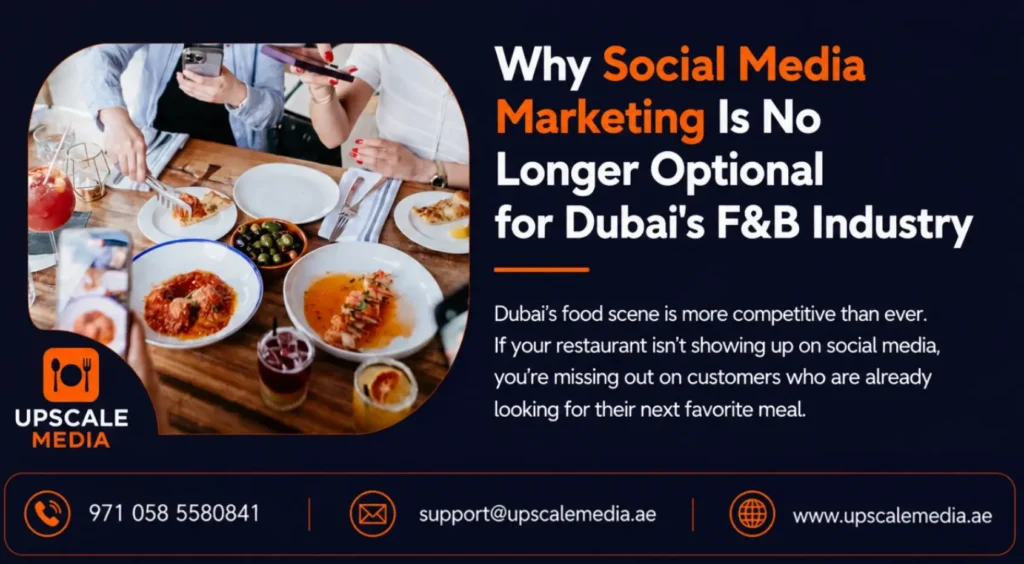
Social Media Marketing: Essential for Dubai’s F&B Scene

Picture this: it’s 8 PM in Dubai, someone’s phone is out, and they’re standing five minutes from three different restaurants, trying to decide where to eat. They’re not flipping through a menu taped to a window. They’re not asking a stranger for directions. They’re scrolling Instagram, TikTok, Google Maps  and whichever restaurant shows up looking the most irresistible in that thirty-second window wins the table. This single moment is exactly why social media marketing matters for Dubai restaurants today. That’s the entire game now. And if your F&B brand isn’t showing up in that scroll, you don’t lose the customer slowly. You lose them instantly, without ever knowing they existed. Social media marketing has stopped being a “nice to have” for Dubai’s food and beverage industry. It’s the infrastructure that decides who gets discovered, who gets forgotten, and who gets fully booked on a random Tuesday. This guide breaks down exactly why with real numbers, real platform behavior, and a few hard truths most F&B owners don’t hear until it’s too late. The Reality of Dubai’s Highly Competitive F&B Industry Before getting into strategy, it’s worth understanding just how unusual Dubai’s F&B landscape actually is. This isn’t a market where restaurants compete gently for attention. It’s one of the most saturated, highest-stakes dining markets on the planet: Dubai has thousands of restaurants competing for the attention of millions of residents and tens of millions of annual tourists. New restaurant licenses are issued by the hundreds every single year, meaning your competition isn’t fixed  it’s growing constantly. The population is wildly multicultural, with a huge expat majority, which means your audience isn’t one type of diner  it’s dozens of different cultural expectations, language preferences, and dining habits, all overlapping in the same city. Consumers here are famously mobile-first, with smartphone penetration among the highest in the world. Great food used to be the differentiator. Now it’s simply the entry fee. The real battle happens on a screen, long before anyone walks through your door. A market this competitive needs a strategy built for it—not a generic one. Upscale Media works exclusively with Dubai’s F&B brands, helping restaurants stand out, attract more customers, and grow faster. Contact Us → Instagram: Where Dubai Still Falls in Love With Restaurants Instagram remains the single most important discovery platform for Dubai’s dining scene. An overwhelming majority of UAE social media users are active on the platform, and for F&B brands specifically, it functions less like a marketing channel and more like a digital menu, a mood board, and a trust signal all at once. What actually performs well on Instagram in Dubai right now: Reels over static posts. The algorithm increasingly favors video content that earns saves and shares, meaning a beautifully shot plating reveal or a sunset rooftop dining clip will travel far further than a plain photo ever could. “Save-worthy” content. Posts that make someone think “I need to try this”  and tap save so they don’t forget  consistently outperform content that’s just pretty to look at. Stories for daily specials and behind-the-scenes. This is where the personality of a brand actually comes through, and where a lot of DM inquiries and reservation requests quietly begin. Interactive elements. Polls asking “which new dish should we launch?” or quizzes about spice levels do more for engagement than another static menu photo. The brands winning on Instagram in Dubai aren’t necessarily the ones with the biggest budgets. They’re the ones treating their feed like an experience, not a brochure. Your Next Customer Is Already Scrolling Turn your social media into a customer magnet with scroll-stopping Reels, food photography, and content built specifically for Dubai’s F&B brands. Contact Us TikTok Has Changed How Dubai Chooses Restaurants Here’s something a lot of F&B owners still underestimate: Dubai is currently one of the most TikTok-saturated cities in the entire world, with an enormous volume of location-tagged content coming out of the city. Food content dish reveals, “hidden gem” discoveries, chef introductions  regularly goes viral within the local feed. What makes TikTok genuinely different from Instagram is distribution. Instagram largely shows your content to people who already follow you. TikTok doesn’t care who follows you  a single well-produced video can land in front of tens of thousands, sometimes hundreds of thousands, of people who’ve never heard of your restaurant before that moment. And unlike a lot of viral content, food videos tend to convert fast: someone sees a dish reveal on TikTok, and the visit often happens that same week, while the craving is still fresh. There’s also a very specific discovery pattern happening across the city right now: someone sees a restaurant on TikTok, immediately searches for it on Google, lands on the Google Business Profile, and decides whether to book based on what they find there. Which brings up an uncomfortable point for a lot of restaurant owners  your TikTok virality is only half the job. If your Google listing looks abandoned once people go looking for you, you lose them at the very last step. Turn TikTok Views Into Real Customers Going viral is only half the battle. We create TikTok content and marketing strategies that turn views into bookings, helping Dubai’s F&B brands grow beyond the algorithm. Contact Us Data & Analytics: Marketing Backed by Numbers, Not Guesswork Every post, story, and ad generates data  who watched, who clicked, who scrolled past in half a second without a second thought. That data is a goldmine that most F&B owners never actually open. Used properly, analytics reveal: Which dishes generate genuine excitement versus which ones just get polite likes What time of day your specific audience is actually online and receptive Which captions and formats drive real bookings, versus which ones look good but convert nothing How your own performance compares to competitors running similar campaigns in the same neighborhood Without this, decisions get made on gut feeling  an owner guessing which dish to push hard, based on personal preference rather than what the data

Social Media Marketing: Essential for Dubai’s F&B Scene Read More »