
Restaurant Marketing Budget: Spend Smarter & Grow Faster
Most restaurant owners don’t struggle with marketing ideas. They struggle with knowing how much of those ideas they can actually afford and where the money should go first.
That uncertainty is expensive. Restaurants that guess at their marketing spend either underinvest and stay invisible, or overspend on the wrong channels and never see the return. Neither mistake is cheap when margins are already thin.
This guide breaks down exactly how to build a restaurant marketing budget that holds up under pressure: how much to allocate, how to split it across channels, how to track whether it’s working, and how to adjust it before small problems become expensive ones.
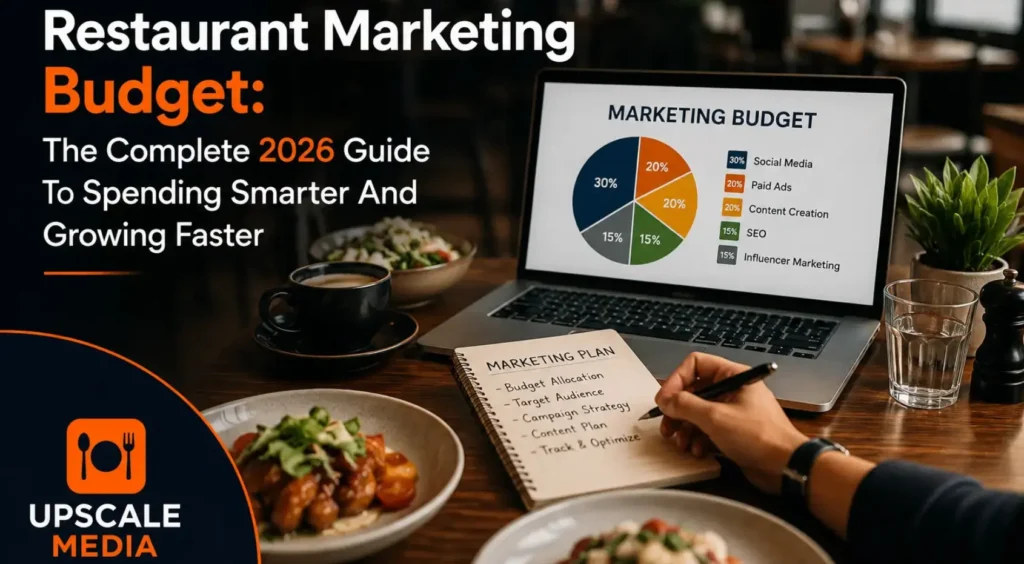
Why Your Restaurant Marketing Budget Deserves a Real Strategy
Marketing is one of the only restaurant expenses that’s supposed to make you money back. Rent, utilities, and payroll keep the lights on. Marketing is what fills the seats.
Treated correctly, your marketing budget should:
- Build visibility in a market where diners rarely walk into a restaurant they’ve never heard of
- Turn first-time visitors into regulars through loyalty programs, email, and consistent brand presence
- Push the right menu items the high-margin ones instead of letting customers default to whatever’s cheapest on the page
- Protect you from competitors who are actively marketing while you sit quiet
A restaurant without a marketing budget doesn’t save money. It just loses customers to the restaurant down the street that’s showing up on Instagram, ranking on Google, and sending an email the moment a diner searches “best brunch near me.”
Restaurants operating in Dubai can also benefit from following the latest tourism and hospitality insights published by the Dubai Department of Economy and Tourism, helping them align marketing budgets with changing visitor demand.
Not Sure Where Your Budget Should Be Going Right Now?
Our restaurant marketing agency in Dubai builds and manages budgets like this for restaurants every day. Get in touch and we'll walk through yours to help you invest where it matters most.
How Much Should Restaurants Actually Spend on Marketing?
There’s no single right number but there is a reliable range, and it shifts depending on where your restaurant is in its lifecycle.
| Restaurant Stage / Type | Recommended Marketing Spend |
|---|---|
| New restaurant (first 12 months) | 8% – 15% of revenue |
| Established restaurant | 3% – 8% of revenue |
| Restaurant aiming for growth | 8% – 12% of revenue |
| Multi-location restaurant groups | 5% – 10% depending on expansion goals |
| Seasonal restaurants | Adjust budget based on demand cycles |
These percentages are general planning guidelines rather than fixed rules. The right marketing budget depends on factors such as location, competition, restaurant type, customer acquisition costs, and business goals. A new restaurant usually requires more investment because it needs to build awareness, while established restaurants can focus more on retention and repeat customers.
Marketing Budget Is a Growth Investment, Not Just a Cost
Marketing is an operating expense for most restaurants, but it should be managed with the mindset of a long-term growth investment. Unlike expenses that only keep the business running, effective marketing creates measurable returns by bringing in new customers, increasing repeat visits, and strengthening brand visibility.
A smart restaurant marketing budget should not be viewed as money spent and forgotten. It should be treated as an investment that requires tracking, testing, and optimization. When budgets become tight, restaurants should analyze performance first and reduce inefficient spending rather than cutting the channels that consistently generate revenue.
The 5-Step Framework for Building Your Restaurant Marketing Budget
Step 1: Audit Your Financial and Marketing History
Before deciding what to spend next, look at what already happened:
- What was your net income and total revenue over the last 12 months?
- Which past campaigns or channels produced the strongest ROI?
- How many first-time customers turned into repeat customers and through which channel?
- Where did money go in with no measurable return?
This audit tells you what’s actually working for your restaurant, not what worked for a case study somewhere else.
Step 2: Set Specific, Measurable Goals
Vague goals like “get more customers” don’t tell you where to put your money. Specific goals do.
Use the SMART framework Specific, Measurable, Achievable, Relevant, Time-bound to turn a wish into a plan. For example:
“Increase weekday lunch sales by 20% over the next quarter by launching an express lunch menu promoted through local search ads and an email campaign to nearby office workers.”
That single sentence already tells you which channels to fund: local search and email.Common goal categories worth choosing between:
- Foot traffic → local SEO, geo-targeted ads, signage, community events
- Online orders → paid search, delivery platform promotion, an optimized ordering page
- Brand awareness → social media, PR, influencer partnerships, and a strong brand identity
- Repeat visits → loyalty programs, personalized email/SMS offers
- New menu launches → email campaigns, influencer seeding, limited-time promotions
Step 3: Run a Fast SWOT Check
Before choosing channels, take 20 minutes to map out:
- Strengths what already draws people in (chef reputation, ambiance, loyal regulars)
- Weaknesses where money is currently leaking with little return
- Opportunities trends you can ride (a rising interest in a cuisine type, an underused location advantage)
- Threats new competitors, rising food costs, shifting dining habits
This step keeps your budget grounded in your restaurant’s actual position, not a generic industry template. If mapping this out on your own feels overwhelming, a restaurant consultant in Dubai can run this analysis with you in a fraction of the time.
Step 4: Choose Channels That Match Your Budget and Audience
Not every channel deserves a slice of your budget. Match the channel to who you’re trying to reach and how much you can spend. Digital channels (generally the better return for most independent restaurants):
- Social media marketing brand building, promotions, community engagement
- Email marketing low-cost repeat-visit driver, ideal for loyalty offers
- SMS time-sensitive promotions and reservation reminders
- Paid search and social ads precise targeting for people actively searching for a place to eat
- Local SEO and Google Business Profile free to optimize, and often the first thing a hungry local sees
- Website the digital home base that supports every other channel
Traditional channels (still relevant for local, community-driven visibility):
- Print and direct mail for openings, seasonal menus, and local promotions
- Local events and sponsorships
- Cross-promotions with nearby businesses (gyms, offices, retail)
A tight budget usually means leaning into organic and low-cost channels first social media, email, and a well-optimized Google Business Profile before layering in paid ads once you can measure what’s converting. If channel selection feels like the hard part, our restaurant marketing agency can map this out against your actual budget and goals.
Step 5: Allocate Using a Proven Split Rule
Rather than guessing percentages from scratch, use a tested allocation model and adjust it to your concept:
60/30/10 split
- 60% to proven, reliable channels (search ads, email, local SEO)
- 30% to channels you’re actively testing (paid social, seasonal content, new platforms)
- 10% to experimental or brand-building efforts (partnerships, storytelling content)
70/20/10 split (a leaner variation for cost-conscious operators)
- 70% to core, proven channels
- 20% to newer tactics worth testing
- 10% strictly reserved for A/B testing and optimization
Either model works. The point is the same: most of your budget should go where you already have evidence of return, with a smaller, clearly defined slice set aside to find the next thing that works.
Sample Restaurant Marketing Budget by Revenue Tier
Here’s how a 5% marketing allocation might realistically break down at different revenue levels, using the 60/30/10 principle as a base
| Annual Revenue | Marketing Budget (5%) | Core Channels (60%) | Testing (30%) | Experimental (10%) |
|---|---|---|---|---|
| $150,000 | $7,500 | $4,500 | $2,250 | $750 |
| $250,000 | $12,500 | $7,500 | $3,750 | $1,250 |
| $500,000 | $25,000 | $15,000 | $7,500 | $2,500 |
| $1,000,000 | $50,000 | $30,000 | $15,000 | $5,000 |
Marketing budgets vary widely depending on location, competition, restaurant category, and business objectives. The figures in this guide should be used as planning benchmarks rather than guaranteed industry standards.
Want to See This Strategy in Action?
Here's how a local burger brand in Dubai grew by following a structured marketing budget and long-term strategy approach. Explore the case study and see the results for yourself.
View Case StudyThe Metrics That Tell You Whether Your Budget Is Working
A budget without tracking is just a guess with a dollar sign on it. These are the numbers that actually tell you what’s happening:
- Cost Per Lead (CPL) total spend divided by number of new customers gained. Spend $300 on ads and gain 30 new customers, and your CPL is $10.
- Return on Ad Spend (ROAS) revenue generated per dollar spent. Spend $500, generate $2,500, and your ROAS is 5:1.
- Customer Lifetime Value (CLV) the total value a customer brings over the life of the relationship. A regular who spends $30 twice a month for two years has a CLV of roughly $1,440.
- Customer Acquisition Cost (CAC) what it costs, in total marketing spend, to acquire a single new customer.
Why the CLV:CAC ratio matters more than any single number:
Comparing CLV to CAC tells you whether a channel is actually profitable long-term, not just cheap upfront. If your CAC is $15 and your CLV is $1,440, that’s a ratio of roughly 96:1 an extremely healthy channel worth scaling. If your CAC climbs to $200 for a customer with a $300 lifetime value, that’s a 1.5:1 ratio, and the channel is barely breaking even once you account for food and labor costs on top of it.
As a rough guide, a CLV:CAC ratio below 3:1 is a signal to pause and re-evaluate a channel before pouring more budget into it.
If You Can't Measure It, You Can't Grow It
Too many restaurants lose money simply because they can't clearly see where their marketing budget is going. We set up the reporting and tracking, so you always know what's working, what's not, and where every dirham is being spent.
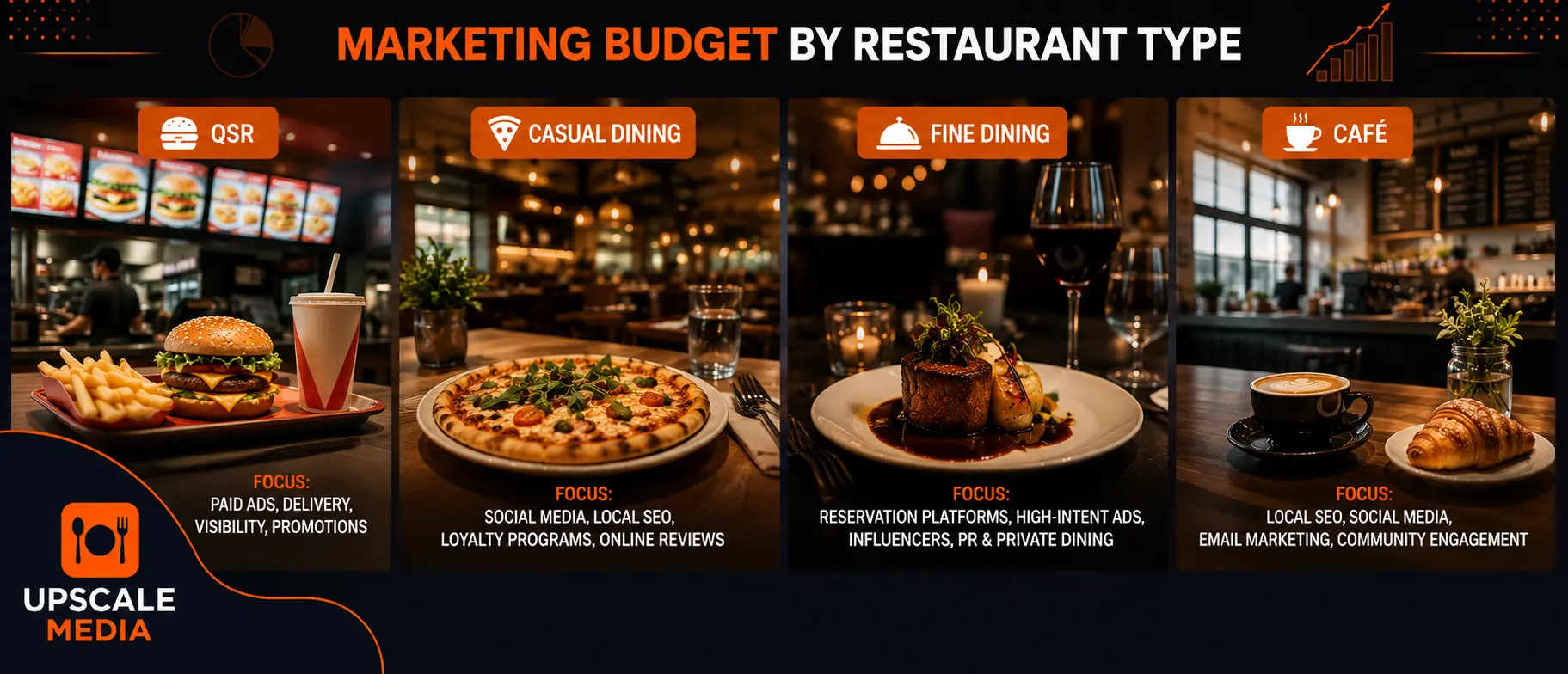
Marketing Budget
by Restaurant Type
Not every restaurant concept should follow the same playbook. Here’s how spending priorities typically shift by type:
| Restaurant Type | Primary Budget Focus |
|---|---|
| Quick-Service (QSR) | Paid ads, delivery platform visibility, promotions, and speed-focused messaging. |
| Casual Dining | A balanced mix of social media, local SEO, loyalty programs, and online reviews. |
| Fine Dining | Reservation-platform visibility, high-intent local search ads, influencer and press coverage, and private dining promotion. |
| New Restaurant (Any Type) | Heavy upfront investment in brand awareness through local SEO, Google Business Profile, opening promotions, and PR campaigns. |
| Multi-Location / Growing Group | Centralized brand campaigns combined with location-specific local SEO and geo-targeted ads for each restaurant site. |
Fine dining in particular benefits from tracking guest lifetime value rather than raw foot traffic a guest who books quarterly for a tasting menu with wine pairings can be worth more than ten walk-ins, which should shape everything from ad targeting to email segmentation. This is also where influencer marketing tends to earn its place in the budget, since a handful of the right food creators can reach exactly the high-intent diners this segment depends on.
Common Restaurant
Marketing Budget Mistakes
1. Pouring money into a channel that isn’t converting. If a campaign isn’t producing measurable results after a fair testing period, redirect that spend rather than hoping it improves.
2. Ignoring free and low-cost opportunities. Word-of-mouth, customer referrals, organic social posting, and a fully optimized Google Business Profile cost time, not money and they often outperform paid channels for local visibility.
3. Forgetting the hidden costs. Software subscriptions, website hosting, photography and content production, and staff time spent on marketing all count against the budget, even when they don’t feel like traditional “marketing spend.”
4. Spreading the budget too thin. Doing three channels well beats doing eight channels poorly. A limited budget performs better when it’s concentrated.
5. Treating the budget as fixed. A marketing budget set once at the start of the year and never revisited misses seasonal shifts, new competitors, and changing customer behavior.
Avoid Costly Budget Mistakes
Sometimes all it takes is an outside perspective to spot what's holding your marketing back. Talk to our team about a budget review before your next quarter starts.
Using AI and Automation to
Improve Marketing Efficiency
One shift that’s changed restaurant marketing over the past couple of years: AI-powered tools now handle work that used to eat directly into the budget.
AI tools can help restaurants save time and improve decision-making, but they work best when combined with a clear marketing strategy.
Restaurants can use AI for tasks such as:
- Creating first drafts of social media captions, email campaigns, and menu descriptions
- Analyzing customer feedback and online reviews
- Organizing customer data for better personalization
- Supporting advertising optimization by identifying performance trends
AI should not replace human strategy or guarantee better results. Instead, it should help restaurant teams work faster, understand customer behavior, and make more informed marketing decisions.
Signs It's Time to Adjust
Your Marketing Budget
Your budget shouldn’t sit untouched for a full year. Revisit it when you notice:
- A steady drop in ROAS or a rising CAC on a channel that used to perform well
- A seasonal shift in traffic (patio season, holidays, local events) that your current spend doesn’t account for
- A new competitor actively marketing in your area
- A menu change, chef change, or expansion that creates a natural reason to lean into promotion
- Fully booked reservations for weeks out a sign you can shift paid spend toward retention and owned channels instead
How Restaurant Owners
Should Review Their Marketing Budget
A restaurant marketing budget should not remain unchanged throughout the year. Customer behavior, competition, seasonal demand, and business goals can all affect performance.
Restaurant owners should review their marketing spending regularly by analyzing:
- Which channels bring the most customers
- Which campaigns generate the highest return
- Customer acquisition costs
- Repeat customer rates
- Seasonal opportunities
Regular reviews help restaurants move money toward strategies that work and avoid wasting budget on activities that do not create measurable results.
Bringing It
All Together
A restaurant marketing budget isn’t a number you set once and forget. It’s a working plan: rooted in your actual financial history, tied to specific goals, split across channels that match your audience, and reviewed often enough to catch what’s working before the money runs out on what isn’t.
Start with the 3–6% baseline if you’re established, push higher if you’re new or growing, and track your CLV:CAC ratio closely enough that you always know which channels are actually earning their place in the budget.
If you’d rather have a team build and manage that budget with you from goal-setting through channel selection and monthly performance tracking explore our restaurant marketing agency in Dubai to see how a structured, data-backed approach can take this off your plate entirely.
Ready for a Smarter Marketing Budget?
Looking to build a data-driven marketing strategy tailored to your restaurant's stage and goals? Talk to our team about a custom marketing budget plan designed for sustainable growth.
FAQ
General Questions
Still not sure you need marketing services? We recommend doing some research or consult with us. We can construct a plan based on your budget to test the waters.
Most established restaurants spend 3–6% of revenue on marketing. New restaurants often need 10–25%, sometimes up to 35% in highly competitive markets, to build initial awareness.
New restaurants typically need to spend more aggressively than established ones — commonly 10% to 25% of revenue in the first year, since there's no existing customer base or brand recognition to rely on.
A ratio of 3:1 or higher is generally considered healthy. Anything below that suggests the cost of acquiring a customer is eating too much into what that customer is actually worth over time.
Both work well. The 60/30/10 model leaves slightly more room for testing new channels, while 70/20/10 is a leaner option for restaurants that want to concentrate spend more heavily on proven channels.
It's best treated as a capital investment (CAPEX) rather than a routine operating expense, since its purpose is to grow the business rather than simply keep it running day to day.
Local SEO, Google Business Profile optimization, email marketing, and targeted paid search tend to deliver the strongest return for most independent restaurants, since they reach people already searching for a place to eat nearby.
At minimum, quarterly — though monthly reviews of key metrics like ROAS and CAC catch underperforming channels faster and prevent wasted spend from compounding.